It’s Time
The CD Rain Poems is now available in an edition limited to 100 signed and numbered pieces: LINK

The CD Rain Poems is now available in an edition limited to 100 signed and numbered pieces: LINK
For years I have been reading books borrowed from the public library or e-books I bought, but last week I broke down and bought three real books when I discovered this publisher: Empty Bowl. I bought three translations from Chinese texts, by Red Pine (aka Bill Porter). They arrived yesterday and are most lovely editions. Except for Zen Roots these small books are not available as e-books.
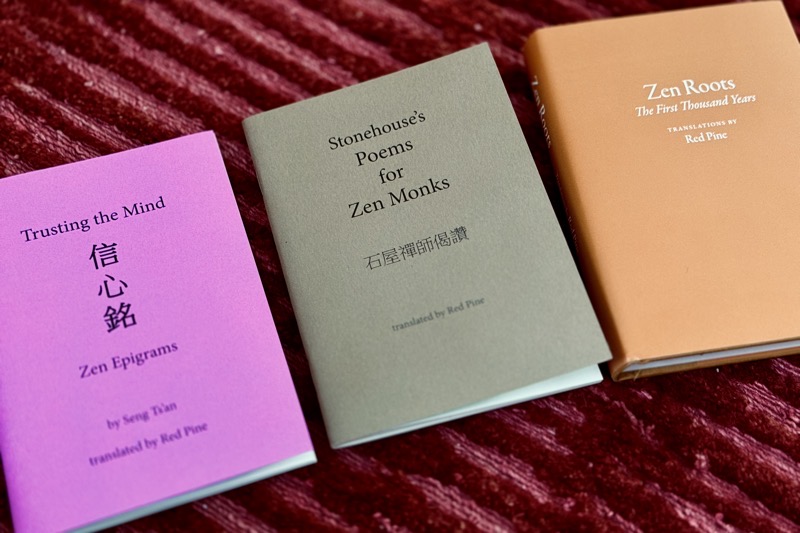
By now I Ihave read Trusting the Mind, by Seng Ts’an, who was the third patriarch of Chan/Zen, twice already. I believe it shall travel with me for a long time, the way a book with the poetry of Ryokan used to.
We tested the new page for selling the Limited Edition Rain Poems CD. Everything seems to be working. CDs are ready. Pens are at hand. The color is black only because it is a special ink (which I had to order from Germany) that dries extremely fast, as not to seep into the plastic of the CD and potentially mess with the zeros and ones archived there.
Since I like the number nine I want to open the gates on Saturday 5/4 @ 0900 Pacific Time, which will be noon on the East Coast. Everything on the webpage is self explanatory. The comment field is for adding a name or dedication. The CD is small so you should limit yourself to “for Elise” or something similarly brief. Happy to write a little more than that on the white space underneath the CD. A word about the foam button the CD is mounted on. I wouldn’t take the CD from it without supporting the foam by putting a finger against it. I mean you might get lucky a few times but it will tear eventually.
A separate post will contain the link to the Rain Poems CD page.
Last night I asked Siri to play some music while I was cooking. It played an interesting mix of music from my library and stuff it decided I should hear, I guess.
At on point Siri decided to play this piece by Oscar Lopez:
I wasn’t paying much attention as I was chopping up onion and garlic – always important to keep the attention on the knife – and so only a few musical phrases entered my consciousness. Like the phrase about 50 seconds into the piece, which sounded like something Jon and I might have played. I checked my phone and noticed the name of the artist.
This morning I looked him up and discovered this article:
After a three-decade music career that established him around the world for exceptional guitar playing, Oscar Lopez has recently been living out of his car in Calgary.
Former band mate James Keelaghan said many artists often don’t have funds for mental health counselling or medication.
Keelaghan and Lopez have been performing off and on in a joint project called The Compadres since 1993.
Keelaghan, who will be performing in Edmonton in March, said finances for musicians were bad during the pandemic and got worse when revenue from CD sales dropped off.
“All that revenue has now gone. Streaming services have completely destroyed a huge swath of our income,” the folk singer-songwriter said.
(I added the emphasis.)
I wish him well and contributed to a Go Fund Me for Oscar Lopez. You can check out the fundraiser here: LINK
When I was in Japan in 1991, I heard abut ST.GIGA, the satellite radio station. It was a very innovative idea. I remember thinking that their slogan was a nice greeting. Presumably it’s the satellite speaking… :-)

St.GIGA is credited as being the world’s first digital satellite radio station. The Satellaview has received praise for being ahead of its time, particularly for St.GIGA’s method of distributing and broadcasting high-quality audio and recordings.
In accordance with Yokoi’s conception, St.GIGA’s broadcasts initially followed no externally fixed (or artificial) timetable. Rather, they were based upon the cyclical motif of a 24-hour “tide table”[4] where broadcast themes were approximately matched to the current tidal cycle according to the rule of twelfths throughout the 24-hour broadcasting period. Under this innovative schedule, the station broadcast a variety of primarily ambient music programs including Music Tide (音楽潮流, Ongaku Chōryū), various jazz programs, and Tide Table (featuring live sound-broadcasts of the ocean shore). The beginnings and ends of programs were not clearly demarcated and instead utilized the unprecedented “Tide of Sound” (音の潮流, Oto no Chōryū) method where songs of one genre would gradually flow into and intersperse with the songs from the prior genre until the new genre became predominant.
“Tide of Sounds” broadcasts operated under a principle of “No Commercials, No DJs, No News Broadcasts, No Talk.” Unlike most commercial-driven radio broadcasts, this was made possible for St.GIGA due to its reliance on a subscription Digital Audio Broadcasting service. In order to receive this DAB service, the subscriber was required to obtain a special decoder, to pay an initiation fee, and subsequent monthly fees. “Tide of Sounds” broadcasts often took the form of high-quality digital recordings of nature sounds accompanied by spoken word narration by an actor as the “Voice”. Throughout the life span of “Tide of Sounds” broadcasts, the part of the “Voice” would be played by a number of notable Japanese poets, including, among others, Ryo Michiko. “Voice” performances often consisted of all new poetry composed specifically for the show.
The Internet Archive has many hours of St. GIGA’s broadcasted program “Tide of Sound” (音の潮流). (LINK)
Enjoy!
