02022-09-08 | Uncategorized
If you want a happy ending, that depends, of course, on where you stop your story.
– Orson Welles.
This morning I was listening to another episode of the History of the English Language podcast. Some of this history of language made me think of the above quote by Orson Welles. It can be applied in many different ways.
If you take Flamenco at face value it is a Spanish folk music. Go back a few years, however, and you will discover multiple influences from around the world. There is the relatively recent influence of Africa, via the Caribbean, of rhythms that became Rumba and Tango. There is the influence of Northern India via the Roma who created Flamenco. But you can go farther back still and hear that much of Flamenco is related to or borrowed from Arabic music. Any Arab drummer would be completely comfortable playing 12/8 rhythms such as Bulería or Soleá.
Something similar can be found in the history of most countries. In England, before the Anglo Saxon immigrants arrived, there were the Celts. In the USA before the arrival of European immigrants, there were native peoples. And if you go even further back those peoples were immigrants who came from the North. Germany, which only became a nation state in 1875, was at one point a bunch of Germanic tribes that went south from Scandinavia and what is now northern Germany.
One might say, how you frame your political agenda depends, of course, on where you stop your history. Don’t stop, I say, always keep going. We are all just visitors anyway.
02022-09-07 | List, Ottmar
The older I become…
- the more I enjoy finding that one musical note that fits the space that surrounds it. If I can find that one note, then I won’t have to play all of the other notes that I would only play because I haven’t found the one note.
- the more I dig Laozi. I often pick up one of several translations of the Tao Te Ching I have and pick a random page to read. It’s always good.
- the less I care about defining myself. Not eating meat, I would not call myself a vegetarian, for example. I am neither a drinker nor a tea-totaler. In my opinion every definition is a new border that has to be guarded in some way, which takes energy away from creativity. This is even more true in terms of music and art. Let the landscape show the lay of the land, rather than a bunch of fences that only make it more difficult to roam. Defining oneself is, perhaps, for younger humans who are figuring out who they are. I have had to live with myself long enough that I don’t need labeling. Religion, politics… the less labels the better. Look at issues and deal with arising problems. Simply create and worry about what it is that was created later…
- the more I re-read a message or an email one more time before I send it off… and often I choose not reply at all
- the more I feel that walking is my favorite mode of moving through a landscape. A car, a bus, and even a bike get you there much faster, but walking simply leaves one more open to encounters, with the surroundings and with other beings.
02022-09-07 | Podcast, World
It was forty minutes before sunrise, and I was about to leave the house to start my morning walk, when my partner suggested a podcast she had discovered. I hadn’t picked anything to listen to yet and so I downloaded the first two episodes of this podcast about the History of English. After an introduction, the host read a text in Modern English, Middle English, and Old English. Those three generations of English sounded very different. To my ears Middle English sounded a bit like Scottish and Old English sounded more like a Scandinavian language. I learned that the power of English lies in its huge vocabulary, the result of the absorption of many words from other languages. I find that this makes Brexit even more puzzling. Perhaps there was a precedent in how Japan adopted a policy to confine itself from the rest of the world, set up by the Tokugawa Shonugate in the 17th century?
After my walk I came across a tweet that quoted this article about a Missouri school district that revives paddling to discipline students. I replied Paddle revival… the desire to go backwards is strong. Hopefully this will lead to horse-drawn carriages soon. :-)
Will an aging population drag cultures backwards? People generally live longer than ever before – although there are exceptions like this: Life expectancy in the United States continued to fall in 2021 for the second year in a row to 76.1 years, the lowest since 1996, showed the report published by the U.S. National Center for Health Statistics (NCHS) last week (link). Is it an aging population, and their fond memories of a fictitious past, or is it, perhaps, the contraction that inevitably follows any expansion.
Tempo dirá… time will tell. Tomorrow I will listen to more of the podcasts about the History of English.
02022-09-05 | Uncategorized
I know the word burrito means little donkey in Spanish. Wrapping food in flat bread is age old. I imagine that millennia ago there was an Egyptian who did this because he was late getting to work on the pyramids. But, who created the burrito and what did that have to do with donkeys?
Burritos are called burritos because a man called Juan Mendez wrap his food in flour tortillas in order to keep it warm and transport it on his small donkey. The word burrito comes from burro which translate to “little donkey” in Spanish.
Once upon a time, in Ciudad Juárez, during the Mexican Revolution, a guy called Juan Méndez used to sell food in a small stand. To keep the food warm, he wrapped it in a giant tortilla. It is believed that the name came because, when the demand grew, he crossed the Rio Grande with a little donkey to sell them.
Juan Méndez, a street vendor in Chihuahua, Mexico, invented the burrito. During the Mexican Revolution in the 1910s, Méndez decided to wrap his food in flour tortillas to keep it warm and transport it on his small donkey. He then realized that wrapping the food in a tortilla was tasty and a good way to serve it.
People from a northwestern state of Mexico, called Sonora, invented the burrito because of its mobility. Burritos in Mexico at the time were not as stuffed and full as they are today in the United States, so they were extremely easy to travel with. This influenced the burrito’s name because it was the donkey’s sidekick in travel.
The burrito was invented in Ciudad Juarez in the 1940s by a street vendor. He portioned the food and wrapped it in a tortilla, making it appropriate for school children, whom he referred to as “burritos” because he believed they were unintelligent.
I copied text as I found it… LOL. Is there a lesson contained in this? Don’t trust everything you find on the internet? Perhaps Wikipedia (link) is a little closer to the truth.
02022-09-05 | Uncategorized
Each person is a river of life. I have found myself nourished by so many strong and beautiful rivers. These photos are moments in lives that I was honored to share in. Intimate, spontaneous, perhaps revealing.
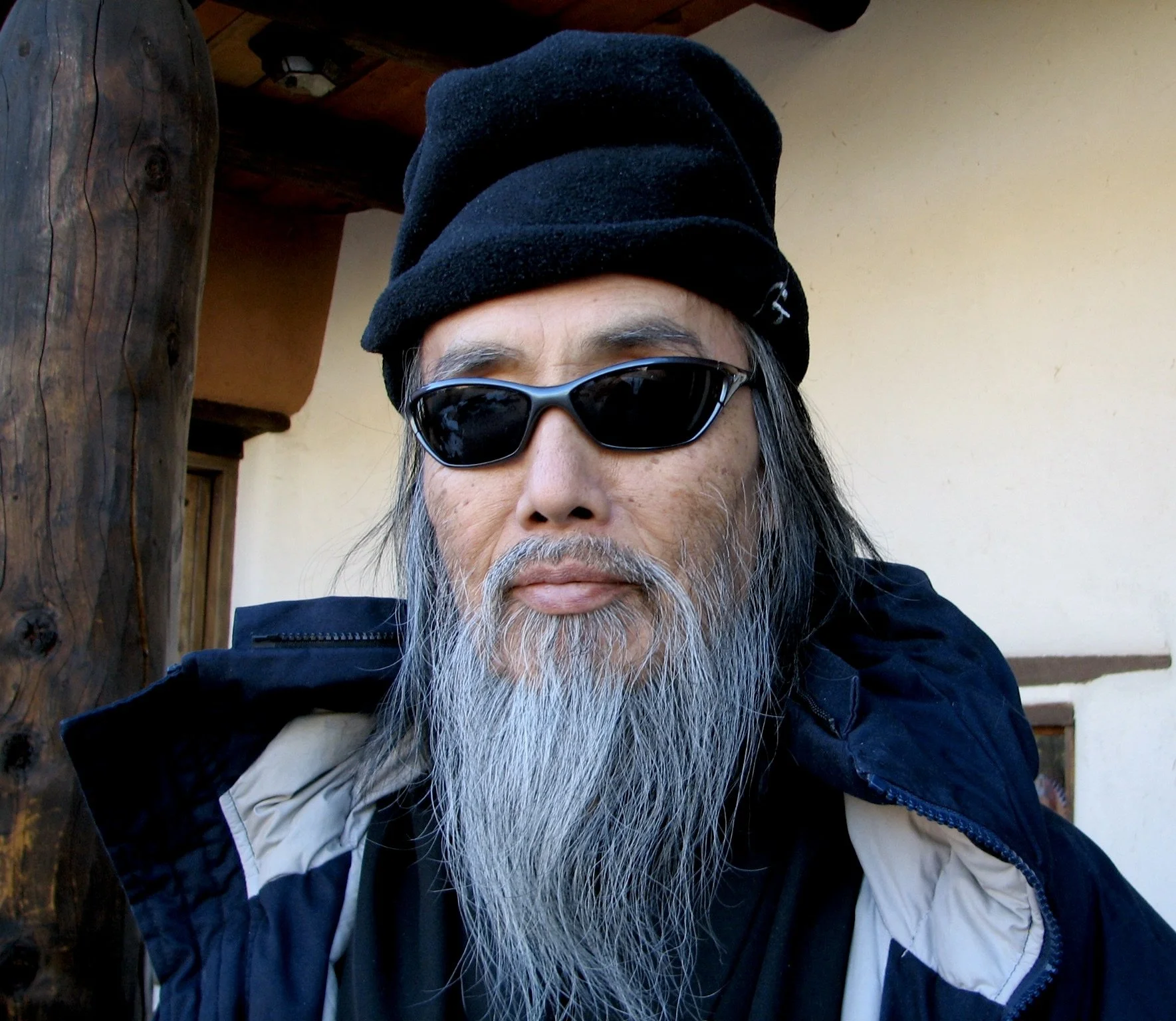
I was looking at images on Roshi Joan Halifax’s website – link – and noticed this cool image of Kaz Tanahashi Sensei. The hat looked familiar and then I noticed the OL logo on the side. Looking good.